
Attentiveness
The natural prayer of the soul

Roughly six months after the 2020 pandemic erupted, six months after sitting in front of webcams in virtual meetings, with school and work switched online, work and personal life blurred, I realized I no longer knew how to pay attention. I was chronically thinking of what was next, pondering how to recover some semblance of work-life balance, all while secretly checking email and newsfeeds during virtual meetings and in the hallway of our house. Even though life was externally slower, on the inside I was frenzied and inattentive.
It slowly dawned on me that I had given away my attention to various mistresses of the attention-economy long before the pandemic started, something that continues to this day. I handed my attention over free of charge with too few questions. In exchange I received endless access to online trivialities and anxious percolating from the device in my pocket. I needed to relearn attentiveness not only for the sake my relationships and work, but in order to recover wholeness in my soul. Simone Weil writes, “Attention, taken to its highest degree, is the same thing as prayer. It presupposes faith and love. Absolutely unmixed attention is prayer.”[1] I need to go on a journey of recovering attentiveness. I need to name it and pursue it.
Within my soul is a longing to hear and see, to know and to express.
I want to hear things that go unheard by others. The erratic pinging of the wood-burning stove and the popping of burning wood. The barely decipherable drops of melted snow pattering onto the roof above me, which is itself covered in light snow. The distant mechanical hum of vehicles racing across the interstate, at times punctuated by the louder sob of semi-truck deceleration. The lofty, nasal whine of small aircraft drifting overhead. The slight skittering of animals on the roof and across the ground outside. To hear these things—to truly hear them—is to begin to understand their real human-shaped or God-made existence in the world around.
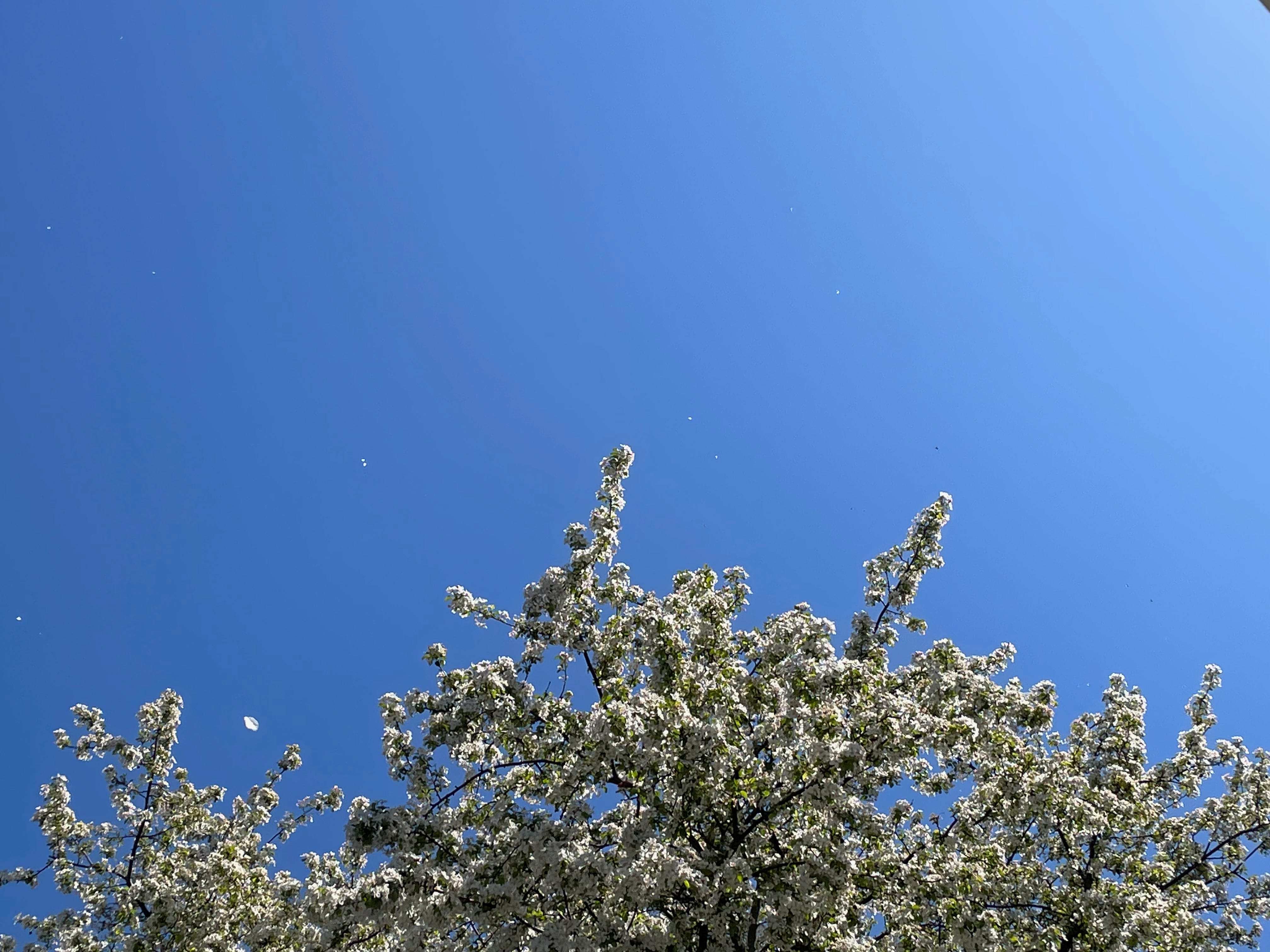
I want to see things swept over by others. The slight tonal variations of color spilling across the snow’s surface played by shadows and textures—so much more than “white snow.” The jittery movements of tall trees, their branches, and the knee-high dry grasses in the wind—just enough to make one seasick if too much attention is given. The intermittent trickle of water flowing off the roof-edge past my window as snow melts—like gems of immeasurable worth dropped with careless rhythm. The rough-grooved difference of bark textures, even in the same type of tree, whether young and green or old and dark. A pole, standing irregularly straight and tall, as it ferries electric and telephone wires in the midst of a stand of trees whose singular diversity is their only conformity. The snow-covered lake reclining in the distance like an immovable field, forever firm and solid, and, so, deceiving us all. The fluidity and changeability of nature—in this moment, now, looking thus, but in less than a second or the next season, so very different. The sun timidly breaking through gray clouds, displaying its light in forced subtlety, striking shadows and brilliance on the snow beyond me and the wood-paneled wall to my right.
How does one see what has become familiar? How can one retrain the eye to observe what has been observed thousands of times without true apprehension? How does one once again attune the soul to wonder when the enchantment of life has been drained away? The Romantic-era poet and painter, William Blake, once wrote, “If the doors of perception were cleansed everything would appear to man as it is, infinite. For man has closed himself up, till he sees all things through narrow chinks of his cavern.”[2] While misused in all sorts of ways, Blake’s words suggest that our natural tendency is toward the clouding of perception and a resulting diminishment of attentiveness that can only be remedied through cleansing of the imagination and senses. It is easier and more natural not to see than to see, and not to hear than to hear. We must work against the grain of our natural tendencies if we are to regain sensory perception and develop deep attentiveness.
John Ruskin, in his monumental work on modern painters of his day, wrote, “The greatest thing a human soul ever does in this world is to see something, and to tell what it saw in a plain way.…To see clearly is poetry, prophecy, and religion—all in one.”[3] What we see or do not see, what we hear or do not hear is the difference between living in one world or another. How is it we can so easily not see and not hear all the wonders around us? How quick to deafness or blindness we are. In our infancy, before we could form words and speak, we were able to see and hear. Yet with the passing of such short time, we unknowingly become blind and deaf, sacrificing our hearing for noisy un-hearing and discarding our seeing for saturated un-seeing.
“What do you see and hear?” At the window, snow covers the ground, and it is quiet.
“No. What do you see and hear?” Sun-bleached snow, striped and painted by long purple shadows and pock-marked with rabbit tracks and occasional detritus of bird seed, leaves, and grass. The red dogwood reaches up from the ground, naked of leaves, in front the solemn row of pines bordering the property. The twin posts holding birdfeeders stand guard like sentinels as the tube feeder twitches in the wind. Aside from that movement, all is still. No birds, squirrels, or other wildlife appear at this hour. A rich, blue sky with only the faintest gray-white clouds stretches out behind the trees and overhead. The earlier rumble of chainsaws and a woodchipper down the road have ceased and a dull, humming silence envelops the atmosphere. I sit in a chair gazing through the quartet of windows facing this scene, one wrinkled by the distortion of ice covering the lower pane near the sill. The warm sun cascades over my back and shoulders, belying the frigid temperatures on the other side of the glass. An airplane roars overhead, from its sound, a prop plane as opposed to a commercial jet. It trails off into the distance and stillness reigns.
What difference does it make whether we see the shifting shadows of the sun on snow or hear the distant hum of vehicles in the air or on nearby roads?
The difference is attentiveness.
In our cars we drive from work to our homes with music blaring, living in a world of aural displacement. We walk quickly from one place to another, talking through our mobile phones to someone in another place, translated to a limbo-like ‘elsewhere’ that is neither here nor there, neither present nor absent. We arrive home knowing we traversed distance but with little to no memory of what we saw or heard en route. We covered ground while being curiously disengaged from everything but ourselves. We have existed in a place somewhere between sound, sight, and soul while not clearly attending to anywhere. In fact, place ceases to matter because we create our own no-place around us. We have existed but not attended. We have encountered occurrence without being attentive.
As children and teenagers we are required to go to school, attending our classes and doing the requisite work. Initially, young children experience the fascination of adventure and discovery. A four-year-old asks her parent each morning with palpable anticipation in her voice, “Do I have school today?” But as time passes, she devolves toward classroom seat-filling until the conclusion of the school day. Teachers take attendance by calling names or checking charts based on bodies in a room. We unconsciously learn that attendance—to attend to something—means simply being bodily present somewhere, regardless of whether we are engaged or attentive in any way.
And so, we attend school. We attend our jobs. We attend recreational, social, or church activities. We attend our lives. But we do so with the masterful distraction of being physically present but soulfully absent. It is an issue of attentiveness, of attending to our lives.
Here and now, I sit quietly at a desk writing these words while gazing out the windows in front of me from time to time. I notice my hand holding the pen that rhythmically scratches lines across a page in order to convey meaning. I notice my hands are chapped from the dry heat of a wood stove in winter. I hear water dripping in rivulets off the roof’s edge through the window at my left. I pay attention to these things.
Attentiveness to the world around us teaches us to slow down. With our senses we apprehend the wonders of creation and the environment in which we find ourselves. But such slowing and attentiveness also trains us toward attentiveness of spirit and the divine.
I stop to consider my inner being, to attend to the life within. I see joy and light derived from a day of solitude to think and reflect. I feel refreshment rising as I relish doing something I love—writing. I hear echoes of anxiety about decisions I must make and uncertainties about the future. I attend to these things. I thank God for the joy, light, and refreshment that is, undoubtedly, a pure gift from Him. I hold up, turn around, and release to God the anxieties and uncertainties. I am attentive in the presence of the all-present and powerfully-now God.
To listen and to apprehend
By slowly unfolding within
The present moment
To unshackle from busyness—
The devil’s hold upon this age—
In simple being
With our eyes unshuttered and ears
Unstopped in explosive, divine,
Ordinary time
To hear so clear what goes unheard
To see indeed what goes unseen
Like life is here now
Now our eyes see saturations
And ears accept resonations
Until now not found
Come, Father, Son, Holy Spirit,
Unleash attentiveness in us
Hearing. Vision. Life.
In Mark’s Gospel, Jesus asks His disciples, “Do you still not see or understand? Are your hearts hardened? Do you have eyes but fail to see, and ears but fail to hear?” (Mark 8:17-18). The disciples had seen and heard. They were with Jesus, even helped Him, when He provided food for groups of five thousand (Mark 6:3-44) and four thousand (8:1-13). They were with Him when He released a man from the oppression of multiple demons (5:1-20) and raised a girl from death (5:21-43). They saw these things happen. They heard the real requests, Jesus’ response, and the stunned awe of those experiencing and viewing Jesus’ presence and power.
But somehow in their seeing and hearing there was, as Jesus put it, a failure. They had eyes but failed to see. They had ears but failed to hear. They took it in but did not truly apprehend. What was going on? The failed to give attention to the divine reality playing out before them.
Still, not too much later, there are indications of increased attentiveness. When Jesus asks them two penetrating questions (“Who do people say I am?” and “Who do you say I am?”), it is clear the disciples are trying their best to put all the pieces together. Peter, ever brash and bold, gives the answer—“You are the Messiah”—but we cannot help but wonder if he really understood what he was saying. Only a teaching later, Peter rebukes Jesus for beginning to unfold His Messianic calling as intermingled with suffering. At the very least, we can acknowledge that the disciples were increasingly attending to and grasping who Jesus was and what that meant for them, for Jesus, and for the world.
Malebranche’s maxim provides focus for us here: “Attentiveness is the natural prayer of the soul.”[4] As the disciples with Jesus in His earthly ministry grew in attention and understanding, so too we can grow in attentiveness and understanding of God in life. But we must learn it. We must re-learn hearing and seeing with the childlike wonder we once enjoyed. We must slow down enough to notice our world and God’s mysterious activity within it. We must de-clutter our senses in a frenzied and content-saturated society. Perhaps we too can learn the natural prayer of the soul that is attentiveness.
[1] Simone Weil, Gravity and Grace (New York: Routledge, 1999).
[2] William Blake, The Marriage of Heaven and Hell (Boston: John W. Luce & Co., 1906), https://www.gutenberg.org/files/45315/45315-h/45315-h.htm.
[3] John Ruskin, Modern Painters, Volume III, Part IV, Chapter XVI – “Of Modern Landscape” [1856], https://www.gutenberg.org/files/38923/38923-h/38923-h.htm#CHAPTER_XVI.
[4] Nicolas Malebranche as quoted in Edward Hirsch, “Heartland,” Poetry Foundation, https://www.poetryfoundation.org/articles/68412/heartland.
Beautiful, Matt.